GEOTECHNICALENGINEERING
ST ALBERT ALBERTA
HomeLaboratoryLaboratory CBR test

Laboratory CBR Test in St. Albert: What It Tells You Before You Pave

Site investigations you can build on.

LEARN MORE

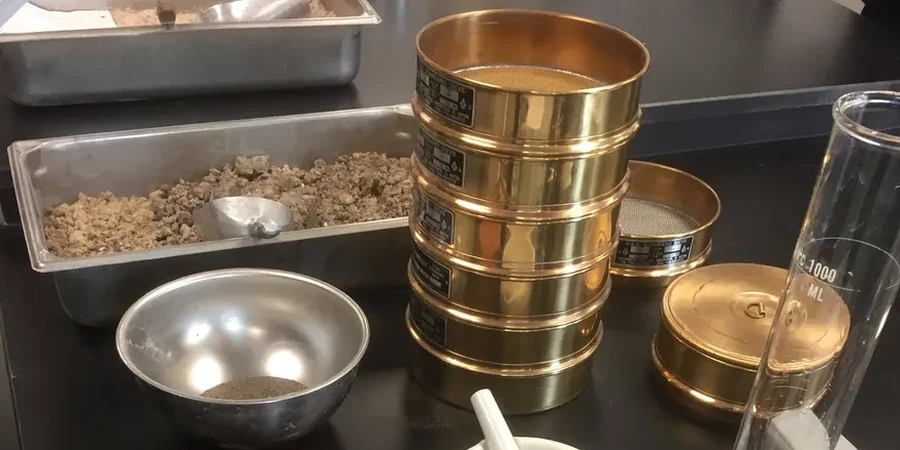
Running a CBR test in St. Albert means dealing with two very different soil profiles depending on which side of the Sturgeon River you’re on. Over in the older neighborhoods like Grandin and Braeside you’ll hit the glacial till fairly shallow—dense, silty clay with some sand lenses, and it usually delivers CBR values above 8% without much trouble. Cross the river into newer subdivisions around Jensen Lakes and suddenly you’re in lacustrine clay that turns to soup when it rains. We’ve seen soaked CBR values drop below 2% in that stuff, which changes your entire pavement design. That’s why we run both soaked and unsoaked specimens as standard practice—because the subgrade you compact in August is not the subgrade you’ll be driving on in April. Before committing to a structural section, many engineers pair the CBR data with a grain size analysis to confirm fines content, especially when the plasticity looks borderline for freeze-thaw durability. And where the subgrade is clearly problematic, we often recommend following up with stone columns as a ground improvement strategy before placing the base course.

A soaked CBR under 2% in St. Albert’s lacustrine clay means your pavement section just tripled in thickness—test it before you budget it.
Our service areas

Our approach and scope

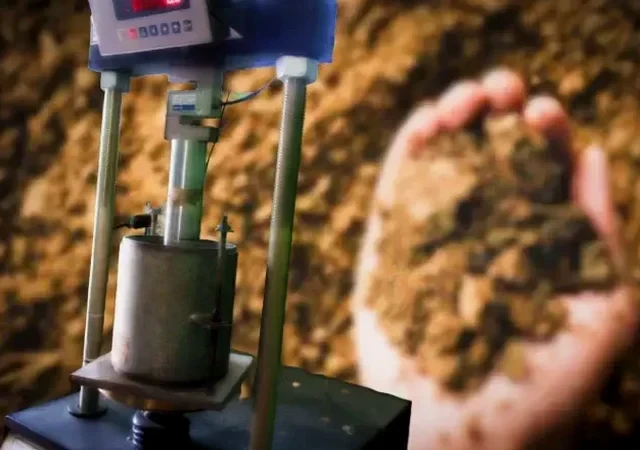
The lab setup we use for St. Albert projects is straightforward but precise. You’ve got a standard CBR mould—152.4 mm diameter, 177.8 mm height—compacted in five lifts with a 4.54 kg rammer, either at standard or modified Proctor effort depending on the spec. The sample sits in a soaking tank for 96 hours with a surcharge weight simulating the future pavement load, and we take swell readings daily because that lacustrine clay from the north side of town can heave 5 or 6 mm before the piston even touches it. Penetration runs at 1.27 mm per minute on a calibrated load frame, and we record the force at 2.54 mm and 5.08 mm penetration. The raw numbers get plotted against the standard crushed stone curve—100% CBR reference—and if the soaked value comes back under 3% we know the native subgrade needs treatment. In St. Albert that usually means over-excavation and replacement with select fill, or sometimes geogrid reinforcement if the city’s transportation department signs off. For granular base materials, a sand cone density test in the field is the natural companion to the lab CBR, confirming that the lift achieved the compaction assumed in the design.
Laboratory CBR Test in St. Albert: What It Tells You Before You Pave
Technical reference — St Albert Alberta

Site-specific factors

St. Albert sits on a mix of glacial Lake Edmonton sediments and till, and the biggest risk factor is the high-plasticity clay found north of the river. When you soak a CBR specimen from that formation, the swell can exceed 4% and the bearing value often falls below 3%—which puts the subgrade in the "very poor" category under the AASHTO soil classification. If your pavement design assumes a 6% CBR and you actually get 2%, the required granular base thickness jumps from 150 mm to over 400 mm. That’s a budget hit nobody wants to explain mid-project. We’ve also seen issues where contractors compact the subgrade wet of optimum to make the clay workable, and the lab CBR on a remolded sample at that moisture content tells a completely different story than the field density test suggests. Winter construction adds another layer: frozen samples brought into the lab need full thaw and reconditioning before compaction, and the CBR result on thawed lacustrine clay is almost always lower than the summer value. The lab test isn’t just a number—it’s a reality check on whether the subgrade can actually carry the traffic loading over a full freeze-thaw cycle.

Need a geotechnical assessment?

Reply within 24h.

Email: info@geotechnicalengineering.vip

Reference standards

ASTM D1883-21 (Standard Test Method for California Bearing Ratio of Laboratory-Compacted Soils), ASTM D698 (Standard Proctor) / ASTM D1557 (Modified Proctor), Alberta Transportation Specification 2.3 (Subgrade Preparation), City of St. Albert Engineering Standards, Section 3 (Roadworks)

Typical values

ParameterTypical value
Mould diameter152.4 mm (6 in)
Mould height177.8 mm (7 in)
Rammer mass4.54 kg (10 lb)
Standard Proctor blows/layer56 (5 layers)
Modified Proctor blows/layer112 (5 layers)
Soaking period96 hours minimum
Penetration rate1.27 mm/min (0.05 in/min)
Surcharge mass4.54 kg minimum per specimen

Common questions

What’s the difference between soaked and unsoaked CBR, and which one does St. Albert require?

Soaked CBR simulates the subgrade after prolonged saturation—think spring melt or a wet fall. Unsoaked CBR reflects conditions right after compaction. The City of St. Albert’s engineering standards follow Alberta Transportation practice, which typically bases pavement design on the soaked CBR value at 95% standard Proctor density. We always recommend running both if your project spans wet-season construction, because the difference between soaked and unsoaked can be 50% or more in the local clay.

How many CBR samples do I need for a residential subdivision in St. Albert?

It depends on the soil variability. In older neighborhoods on the glacial till side, one test per 500 m of road alignment is often enough. In the newer subdivisions north of the river where lacustrine clay dominates, we recommend one per 200 m or at every change in visual soil classification. The Alberta Transportation field sampling guide suggests a minimum of three representative samples per soil unit, but in St. Albert’s interlayered deposits we’ve found that five or six gives a much more reliable design value.

What does a laboratory CBR test cost in the St. Albert area?

A single-point soaked CBR test with Proctor compaction and swell measurement typically runs between CA$180 and CA$290, depending on whether it’s standard or modified effort and how many moisture points you need. A full CBR-moisture curve with four or five points is at the upper end of that range. Turnaround is usually five to seven business days from sample drop-off.

Can you run the CBR test on granular base material or just on subgrade?

We run CBR on both. For subgrade soils we follow ASTM D1883 with the standard or modified Proctor compaction, soaked 96 hours. For granular base course—like the 20 mm crushed gravel used in St. Albert’s road structure—we compact at the specified density and test unsoaked, since free-draining granular won’t hold water for the soak period. The procedure is the same but the sample prep and moisture conditioning differ.

Location and service area

We serve projects in St Albert Alberta and surrounding areas.

View larger map