GEOTECHNICALENGINEERING
ST ALBERT ALBERTA
HomeLaboratoryGrain size analysis (sieve + hydrometer)

Grain Size Analysis (Sieve + Hydrometer) in St. Albert – ASTM-Compliant Particle Distribution

Site investigations you can build on.

LEARN MORE

The National Building Code of Canada (NBCC 2020) makes specific demands on granular classification, and in a place like St. Albert, where glaciolacustrine clays sit beside coarse outwash deposits, the difference between a silt and a clay has real structural consequences. Our grain size analysis combines mechanical sieving for the coarse fraction with a hydrometer sedimentation test for fines passing the No. 200 sieve, following ASTM D422 and the hydrometer-specific ASTM D7928. We have run these dual-method tests on soils from the city’s northwest industrial parks, the residential expansions near Ray Gibbon Drive, and the mixed terrains south of Big Lake, where the contact between sand lenses and sensitive clay layers demands a complete particle-size curve to get the soil classification right. Because the hydrometer portion is temperature-sensitive and requires precise preparation with sodium hexametaphosphate as a dispersing agent, we process these samples in a controlled laboratory environment, not in a field trailer, so the results hold up when a geotechnical engineer needs them for frost heave susceptibility or drainage design in the Sturgeon River basin. When the project involves deep foundations in the city’s lacustrine plains, we often pair the grain size distribution with an Atterberg limits test to confirm plasticity characteristics, since a soil’s behavior under load changes dramatically once the fines content exceeds 15 percent in this region.

A single hydrometer reading taken without temperature correction in a St. Albert winter lab can shift your clay fraction by 8 percent — and that shifts your foundation design assumptions.
Our service areas

Our approach and scope

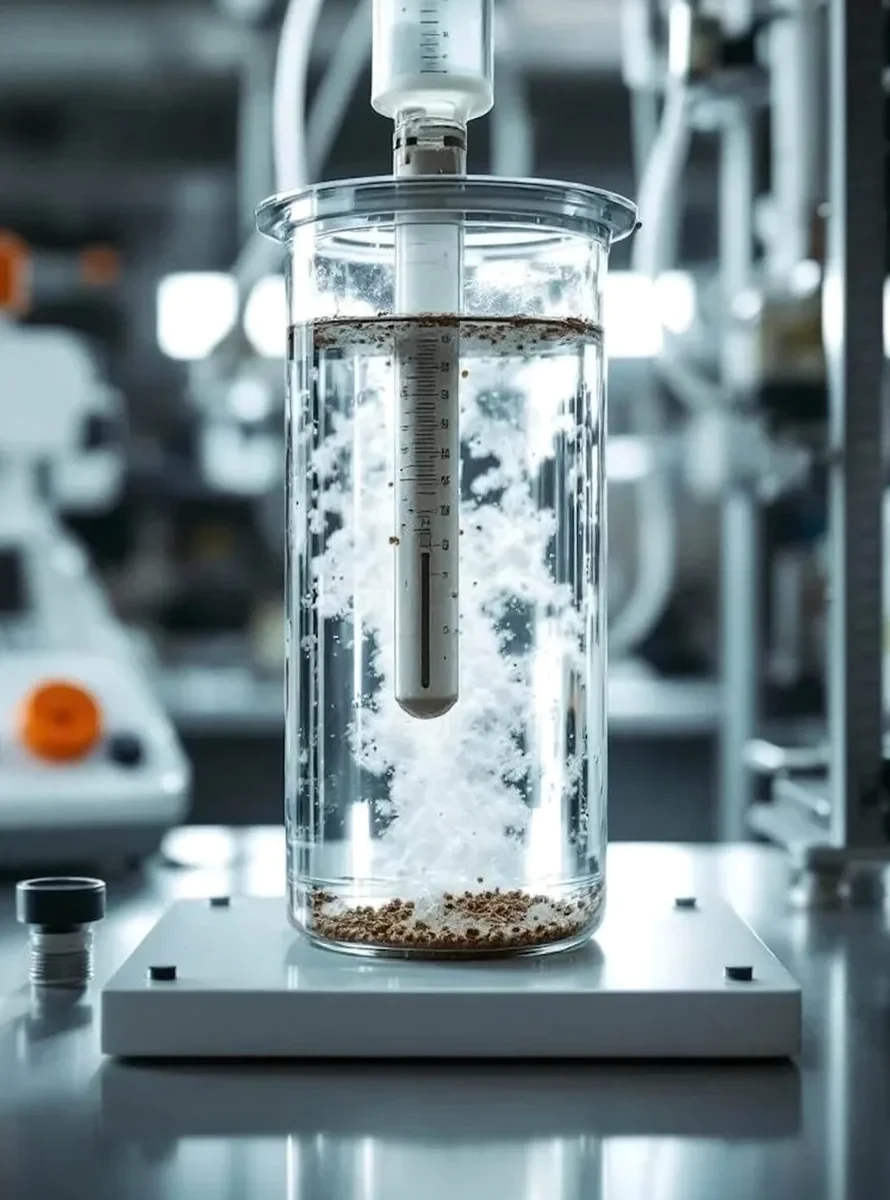
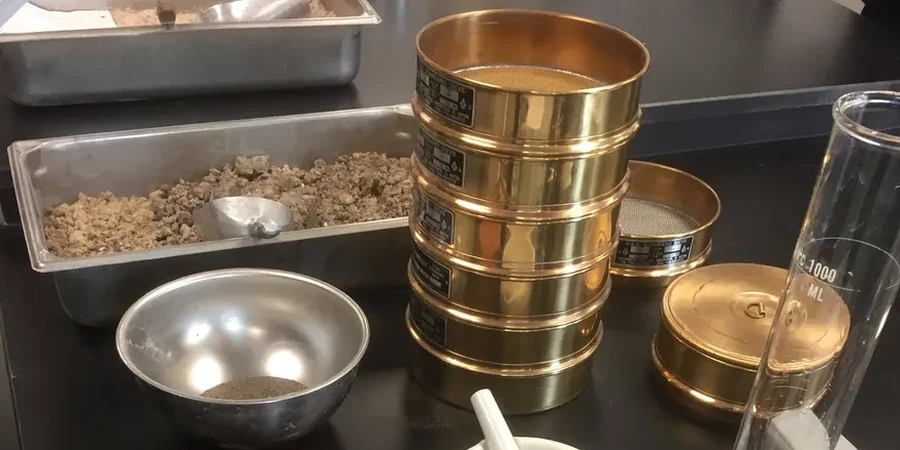
The laboratory setup we use for St. Albert projects starts with a stacked nest of ASTM E11 sieves, from 4.75 mm down to the 75-micron No. 200, mounted on a mechanical shaker that runs a timed cycle to ensure consistent particle separation without breaking fragile grains. For the hydrometer phase, we draw from a calibrated 152H hydrometer suspended in a sedimentation cylinder filled with a 50-gram specimen that has been soaked in a deflocculating solution for a minimum of 16 hours — a step that is non-negotiable because the glaciolacustrine clays found across the St. Albert plateau flocculate aggressively in plain water and would yield a falsely coarse reading. Temperature corrections are applied at each reading interval, typically at 2, 5, 15, 30, 60, 120, and 1440 minutes, and the results are plotted on a semi-logarithmic graph showing percent finer versus grain diameter in millimeters. This combined curve allows us to calculate the coefficient of uniformity (Cu) and coefficient of curvature (Cc), which together inform whether a granular material is well-graded enough for use as engineered fill beneath the frost line — a practical concern for every contractor working in Alberta’s 2.5-meter frost penetration zone.
Grain Size Analysis (Sieve + Hydrometer) in St. Albert – ASTM-Compliant Particle Distribution
Technical reference — St Albert Alberta

Site-specific factors

The most common mistake we see in St. Albert is a contractor ordering a quick wash-200 analysis and assuming the result tells them everything about the fines. It does not — a wash tells you the percentage passing the 75-micron sieve but nothing about whether those fines are silt or clay, and in the city’s older neighborhoods like Grandin and Braeside, where the soils often contain a mix of plastic lacustrine clay and non-plastic rock flour from glacial grinding, that distinction controls both drainage behavior and volume change potential. We have been called in to re-test samples after a project was delayed because the initial classification misidentified a clayey silt as a clean sand, leading to an underdesigned subdrainage system that failed during the spring thaw. The full sieve-plus-hydrometer analysis removes that ambiguity by providing the full particle-size distribution curve, which the geotechnical engineer can then use alongside Atterberg limits to assign a proper USCS group symbol — a classification that stands up to the permitting review process in St. Albert’s engineering department and to the reality of freeze-thaw cycling in a Zone 3b climate.

Need a geotechnical assessment?

Reply within 24h.

Email: info@geotechnicalengineering.vip

Reference standards

ASTM D422-63 (2007) – Standard Test Method for Particle-Size Analysis of Soils, ASTM D7928-21 – Standard Test Method for Particle-Size Distribution (Gradation) of Fine-Grained Soils Using the Sedimentation (Hydrometer) Analysis, ASTM E11-22 – Standard Specification for Woven Wire Test Sieve Cloth and Test Sieves, NBCC 2020 Division B, Part 4 – Structural Design (referenced for soil classification requirements), CSA A23.3-19 – Design of Concrete Structures (referenced for foundation subgrade characterization)

Typical values

ParameterTypical value
Sieve range (coarse fraction)4.75 mm to 0.075 mm (No. 4 to No. 200)
Hydrometer range (fine fraction)0.075 mm to approximately 0.001 mm
Specimen mass (hydrometer)50 g passing No. 10 sieve, oven-dried
Dispersing agentSodium hexametaphosphate (40 g/L solution)
Sedimentation periodMinimum 24 hours, with readings at standard intervals
Temperature correctionApplied per ASTM D7928, ±0.5°C precision
Reporting outputSemi-log grain size distribution curve, Cu and Cc calculated

Common questions

How much does a grain size analysis (sieve plus hydrometer) cost for a St. Albert project?

The combined sieve and hydrometer test typically runs between CA$140 and CA$250 per sample, depending on whether the sample requires pre-treatment for organic content or carbonates, which is sometimes needed with soils taken from the Sturgeon River lowlands. Standard turnaround is included in that range; expedited processing carries an additional charge.

Why do you need a hydrometer test if the sieve analysis already shows the material is mostly fine?

The sieve analysis stops at the No. 200 sieve (0.075 mm) and only tells you the total percentage of fines. The hydrometer sedimentation test continues down to the colloidal range — roughly 0.001 mm — and distinguishes between silt-sized and clay-sized particles. In St. Albert, where glaciolacustrine deposits often contain both rock flour (silt) and plastic clay in the same formation, that distinction is essential for predicting how the soil will behave under moisture changes and freeze-thaw cycling.

Can I use a grain size analysis alone to classify my soil for foundation design in Alberta?

Grain size distribution gives you the particle-size portion of the classification picture, but the Unified Soil Classification System (USCS) also requires the Atterberg limits — liquid limit and plastic limit — for fine-grained soils. We recommend pairing the sieve and hydrometer test with Atterberg limits testing so the geotechnical engineer can assign a complete USCS group symbol. This is standard practice for any project submitting foundation designs to the City of St. Albert for permitting review.

Location and service area

We serve projects in St Albert Alberta and surrounding areas.

View larger map