GEOTECHNICALENGINEERING
ST ALBERT ALBERTA
HomeSlopes & WallsSlope stability analysis

Slope Stability Analysis for Development Across the Sturgeon Valley

Site investigations you can build on.

LEARN MORE

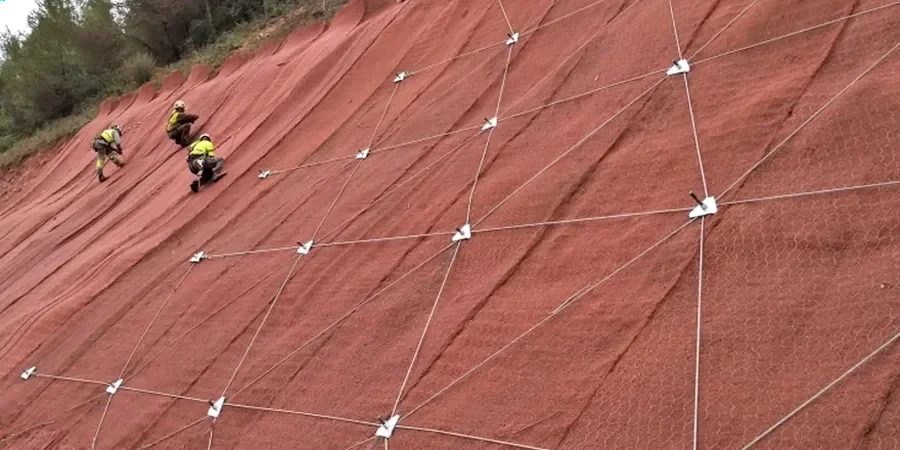
One of the most persistent mistakes we see in St. Albert is treating the river valley slopes as uniform clay till, when in reality the stratigraphy can shift from dense till to soft lacustrine deposits within a single lot. A generic desktop study won't catch that. We provide slope stability analysis that begins with site-specific drilling and lab testing, because the failure mode on a 4:1 slope backing onto the Sturgeon River is fundamentally different from what you'd design for a shallow embankment in a flat subdivision. When the project involves retaining walls or deep cuts near the river terrace, integrating our retaining wall analysis with the slope model prevents the kind of compound failure that standard software misses when boundary conditions are simplified.

A slope that stands through a dry August in St. Albert has very little to say about how it will behave during the first significant thaw cycle in March.

Our service areas

Our approach and scope

In St. Albert, we often find that the critical slip surface isn't where the client expects it — it migrates deeper when you account for the pre-sheared clay seams that run through the glacial till. Our approach pairs limit equilibrium modeling with shear strength parameters measured directly from undisturbed Shelby tube samples, not just back-calculated from SPT blow counts. For cuts exceeding six metres, we run coupled stress-pore pressure analyses to capture the hydraulic response during spring melt, which is when most local slope movements initiate. On projects where granular fill is being considered to improve drainage, we also evaluate the interaction with stone columns treatment, since the stiffness contrast between the improved zone and the native clay can create a new failure path that wasn't present in the untreated slope.
Slope Stability Analysis for Development Across the Sturgeon Valley
Technical reference — St Albert Alberta

Site-specific factors

A townhouse development on St. Albert's north side lost six metres of backyards in one season because the geotechnical report assumed a homogeneous clay profile, missing a thin silt lens that acted as a perched aquifer. The water pressure built up behind the slope face, and the failure occurred on a Saturday morning after three days of steady rain. Nobody was hurt, but the remedial anchored wall cost more than the original foundation scope. We now insist on at least two piezometer nests for any slope taller than five metres within the Sturgeon Valley, and we run sensitivity analyses where we deliberately lower the shear strength in suspect layers to see if the factor of safety drops below 1.0. That kind of scenario testing, combined with deep excavation monitoring protocols when construction starts, turns a probabilistic risk into a managed condition that the contractor can work with.

Need a geotechnical assessment?

Reply within 24h.

Email: info@geotechnicalengineering.vip

Reference standards

NBCC 2020 – Seismic hazard and foundation design provisions, CSA A23.3-19 – Design of concrete structures (retaining elements), ASTM D7181 – Consolidated undrained triaxial compression test for cohesive soils, ASTM D1587 – Thin-walled tube sampling of soils, Canadian Foundation Engineering Manual (CFEM) 4th Ed. – Slope stability analysis

Typical values

ParameterTypical value
Minimum Factor of Safety (long-term, drained)1.5 per NBCC 2020
Minimum Factor of Safety (short-term, undrained)1.3 per CSA guidelines
Analysis MethodLimit equilibrium (Spencer / Morgenstern-Price)
Shear Strength InputEffective stress (c', φ') from triaxial CIU with pore pressure measurement
Groundwater ConditionSteady-state seepage modeled from piezometer data
Seismic Coefficient (kh)0.05 for St. Albert (Seismic Category 2, NBCC)
Typical Critical Slip Depth in Sturgeon Valley8 to 14 metres below crest

Common questions

What does a slope stability analysis cost for a typical residential lot in St. Albert?

For a single-family lot with access for drilling equipment, the analysis typically ranges from CA$1,840 to CA$5,140 depending on the number of boreholes required, the depth of the slope, and whether laboratory triaxial testing is needed. Complex sites with multiple failure planes or instrumentation will fall at the upper end of that range.

Does the City of St. Albert require a slope stability report for building near the river valley?

Yes. The City's planning department routinely requests a geotechnical slope stability assessment for any development within the Sturgeon Valley or near designated escarpment areas. The report must demonstrate a minimum factor of safety of 1.5 under long-term drained conditions, consistent with NBCC 2020 and accepted geotechnical practice.

How long does the analysis take from start to finish?

A standard slope stability study in St. Albert takes about three to four weeks. One week is typically needed for drilling, sampling, and installing piezometers, another two weeks for triaxial shear testing in the lab, and a final week for modeling, report writing, and peer review. Winter drilling takes a few extra days because of frost penetration in the upper metre.

Can you analyze an existing slope that is already showing cracks?

We can, and we approach it differently than a new design. For a slope with active distress, we first survey the crack pattern and measure displacement rates, then run a back-analysis assuming a factor of safety just below 1.0 to determine the in-situ shear strength. That gives us a calibrated model we use to design the remediation without over-building.

Location and service area

We serve projects in St Albert Alberta and surrounding areas.

View larger map