GEOTECHNICALENGINEERING
ST ALBERT ALBERTA
HomeGround improvementStone column design

Stone Column Design for Alberta Ground Conditions

Site investigations you can build on.

LEARN MORE

The National Building Code of Canada sets the baseline, but here in St Albert the real work starts when you hit the glacial stratigraphy. Our team deals with the lacustrine clays and silty tills that define the Sturgeon River valley every day. Stone column design in this part of Alberta has to account for frost penetration reaching 2.4 meters and a seasonal high water table that shifts the effective stress faster than standard assumptions predict. When a developer calls us about a low-rise commercial pad near Ray Gibbon Drive, we already know the overconsolidated crust is thinner than the borehole logs from twenty years ago suggest. We pair the CPT test with laboratory consolidation data to calibrate the settlement reduction factor instead of relying on generic Priebe charts alone, because the laminated silts here behave nothing like the uniform sands those charts were built for.

A stone column is only as good as the triaxial test on the local aggregate you feed into the Priebe method.

Our service areas

Our approach and scope

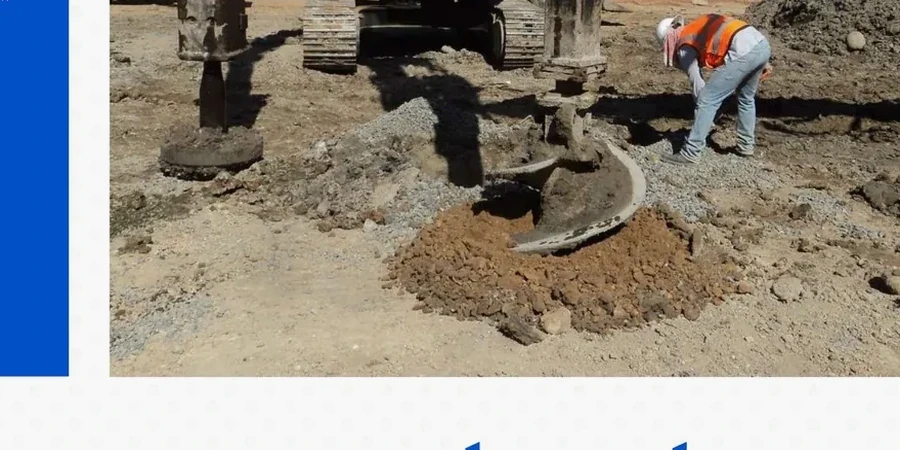
A common mistake we see with St Albert builds is specifying a friction angle of 38 degrees for the crushed gravel backfill just because it came from a supplier spec sheet in Edmonton. The local aggregate from the Villeneuve pit is more angular and its peak strength degrades under repeated loading if the column is not properly confined by the surrounding native clay. We run large-scale triaxial tests on the exact stone gradation the contractor plans to use, then model the composite cell stiffness with axisymmetric finite elements. The difference in predicted settlement compared to using generic parameters can be 12 millimeters or more, which sounds minor until you are dealing with a tilt-sensitive medical clinic slab. Our process also integrates in-situ permeability testing because if the clay matrix drains too slowly, the stone columns act as vertical wicks that accelerate consolidation beyond what the structural engineer expects in the serviceability limit state.
Stone Column Design for Alberta Ground Conditions
Technical reference — St Albert Alberta

Site-specific factors

St Albert started as a modest Métis settlement along the Sturgeon River and only got its first traffic bridge in 1915. That means the oldest commercial lots near Perron Street sit on fill that was never engineered, just pushed into the oxbow depressions when the river was realigned. When we design stone columns for a renovation or an infill project in these blocks, we assume nothing about the bearing stratum until we see the CPT tip resistance climb above 4 MPa. If the fill contains buried organics or old timber cribbing, differential settlement can localize between columns and create a wavy floor profile that no amount of structural slab reinforcement can mask. The risk is not just geotechnical failure, it is a finished building that never meets the floor flatness tolerance and triggers a dispute between the general contractor and the owner six months after occupancy.

Need a geotechnical assessment?

Reply within 24h.

Email: info@geotechnicalengineering.vip

Reference standards

NBCC 2020 Division B Part 4, CSA A23.3-19 Annex G, ASTM D1586 (SPT correlation for composite ground modulus)

Typical values

ParameterTypical value
Typical column diameter0.6 to 1.0 m
Area replacement ratio10 to 35 percent
Stone friction angle (Villeneuve source)40 to 44 degrees
Clay undrained shear strength25 to 75 kPa
Settlement reduction factor (n)1.5 to 3.5
Design frost depth (St Albert)2.4 m below grade
Typical column spacing1.5 to 3.0 m on center

Common questions

What does stone column design cost for a typical lot in St Albert?

For a standard commercial lot in St Albert, the design package including CPT investigation, laboratory consolidation on Shelby tube samples, and the composite cell analysis typically runs between CA$2.000 and CA$7.280 depending on how many column zones the geotechnical profile requires. A simple uniform grid on a flat site sits at the lower end; a variable pattern with three different replacement ratios across an irregular footprint moves toward the upper end because the modeling time increases with each distinct soil unit.

How do you account for frost heave in the stone column design?

We specify a clean, free-draining stone with less than 5 percent fines passing the 75-micron sieve and place a rigid insulation layer beneath the structural slab. The column heads are terminated 300 millimeters below the frost penetration depth, so any heave pressure acts on the granular inter-column fill rather than jacking the foundation element itself.

Why not just use driven piles instead of stone columns in St Albert clay?

Piles make sense when you need to bypass the soft clay entirely and bear on the glacial till or bedrock. Stone columns become the better value when the soft zone is less than 8 meters thick and the structural loads are modest, because you avoid the cost of a structural suspended slab and the pile caps. You also get the drainage benefit which reduces long-term consolidation settlement in the clay matrix.

What QA testing do you perform during stone column installation?

We run a combination of SPT energy-calibrated checks and zone load tests on a minimum of 5 percent of the installed columns. The acceptance criterion is a composite modulus back-calculated from the plate load curve that meets or exceeds the design value, not just a visual inspection of the gravel feed rate.

Location and service area

We serve projects in St Albert Alberta and surrounding areas.

View larger map