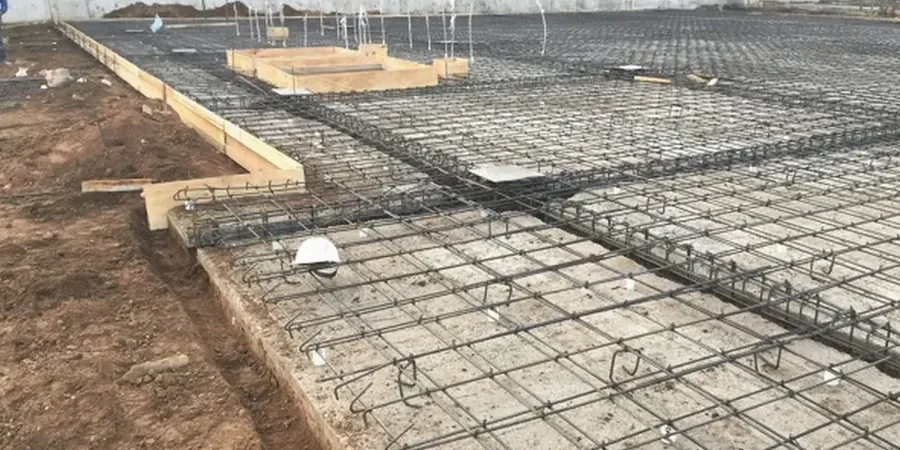
St Albert sits squarely on the floor of former Glacial Lake Edmonton, a fact that defines every excavation and footing decision from the Sturgeon River valley up into the Erin Ridge neighbourhoods. Beneath the topsoil, the typical stratigraphy runs to soft, compressible glaciolacustrine silts and clays that can reach thicknesses of 20 metres before hitting competent till or bedrock. When a conventional spread footing pushes bearing pressures into that kind of profile, differential settlement becomes a matter of when, not if. A properly engineered mat foundation bridges these variable subsoils by distributing structural loads across a continuous reinforced slab, reducing unit pressures to levels the native clay can actually sustain. Our laboratory—accredited to ISO 17025 for mechanical testing on soils—runs the necessary consolidation and triaxial programs to build the compressibility model that feeds directly into the raft geometry, ensuring the design reflects the real layered stratigraphy sampled from the site.
On St Albert’s lacustrine clay, a mat foundation routinely cuts differential settlement by half compared with isolated footings—while eliminating the cost of deep piling on single-family slabs.