GEOTECHNICALENGINEERING
ST ALBERT ALBERTA
HomeLaboratoryTriaxial test

Triaxial Testing in St Albert: Shear Strength Data for Alberta Projects

Site investigations you can build on.

LEARN MORE

Last winter we ran a triaxial program for a six-storey mixed-use on St Albert Trail. The site sat on glacial till with a high silt content. The client needed drained and undrained parameters. We used consolidated-undrained triaxial tests with pore pressure measurement. That gave the design team effective stress parameters in ten days. In St Albert, the till varies block by block. Some zones are dense. Others are softer with higher moisture. A triaxial test removes the guesswork. It gives you the friction angle and cohesion you need for bearing capacity and slope checks. We run these tests in our ISO 17025 accredited lab. No delays. No re-tests.

A 20% error in friction angle can push a factor of safety below 1.0. Triaxial testing in St Albert eliminates that risk with direct measurement.
Our service areas

Our approach and scope

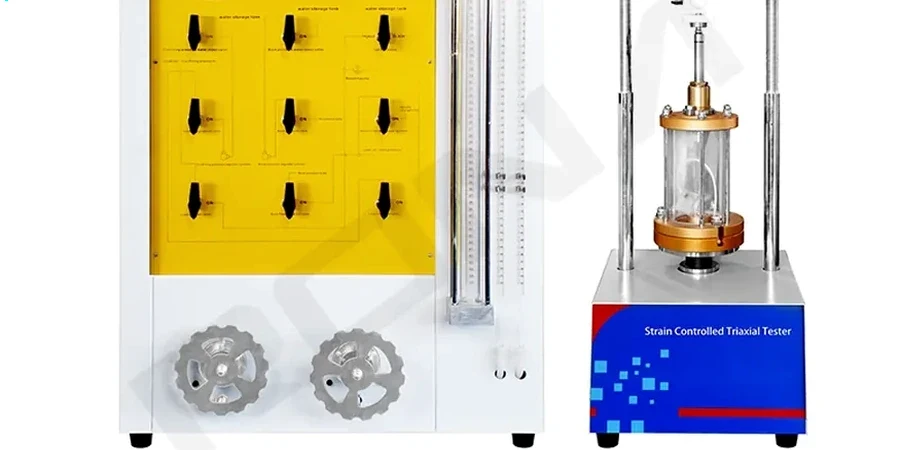
The triaxial test applies confining pressure around a cylindrical soil specimen. Then it loads the sample axially to failure. We run three types in St Albert projects. Unconsolidated-undrained for short-term clay stability. Consolidated-undrained with pore pressure measurement for effective stress analysis. Consolidated-drained for free-draining soils. Our lab uses automated systems. That means consistent strain rates and accurate pore pressure readings. The output is a Mohr-Coulomb failure envelope. You get the drained friction angle, undrained shear strength, and cohesion intercept. For sensitive St Albert silts, we also recommend a CPT test to cross-check the undrained strength profile before finalizing foundation depths. The triaxial data integrates directly with PLAXIS and GeoStudio models.
Triaxial Testing in St Albert: Shear Strength Data for Alberta Projects
Technical reference — St Albert Alberta

Site-specific factors

St Albert grew fast along the Sturgeon River valley. Older neighborhoods sit on stiff till. Newer developments push into lower areas with thicker clay and silt. That contrast creates risk. A standard penetration test gives you an N-value. That is not enough for critical stability calculations. You need the stress-strain curve from a triaxial test. We have seen projects where the friction angle was overestimated by 20%. That leads to shallow factors of safety. In one case, a retaining wall design had to be revised after we ran consolidated-drained tests on a silty clay from a site near Big Lake. The triaxial data changed the wall dimensions and saved the owner from a long-term movement problem.

Need a geotechnical assessment?

Reply within 24h.

Email: info@geotechnicalengineering.vip

Reference standards

ASTM D4767 – CU with pore pressure measurement, ASTM D7181 – CD triaxial compression test, NBCC 2020 – structural design referencing soil parameters, CSA A23.3 – concrete structures, foundation subgrade input

Typical values

ParameterTypical value
Test typesUU, CU with pore pressure, CD
Specimen diameter50 mm and 70 mm
Confining pressure range50 kPa to 800 kPa
Pore pressure measurementElectronic transducer, ±0.5 kPa accuracy
Strain rate control0.01 to 1.0 mm/min
Output parametersc', φ', cᵤ, E, stress path
Reporting standardASTM D4767, ASTM D7181
Turnaround7–10 business days for 3 specimens

Common questions

How many specimens do you need for a triaxial test program?

We typically run three specimens from the same tube sample at different confining pressures. That builds the Mohr-Coulomb failure envelope. For a complete site characterization in St Albert we recommend one set per distinct soil layer.

What is the turnaround time for triaxial testing in St Albert?

For a standard three-specimen CU set, we deliver the report in 7 to 10 business days. Drained tests take longer because of the slow strain rate. We can expedite for an additional fee if the project schedule demands it.

How much does a triaxial test cost?

A full three-specimen triaxial test program in the St Albert area runs between CA$2,770 and CA$3,560, depending on the test type (CU or CD) and the number of confining stages. We provide a firm quote after reviewing the borehole logs.

Do you handle sample extrusion and transport?

Yes. We coordinate with the drilling crew in St Albert. We pick up the Shelby tubes, extrude the samples in our lab, and inspect for disturbance before trimming specimens. You do not need to arrange separate logistics.

Location and service area

We serve projects in St Albert Alberta and surrounding areas. More info.

View larger map